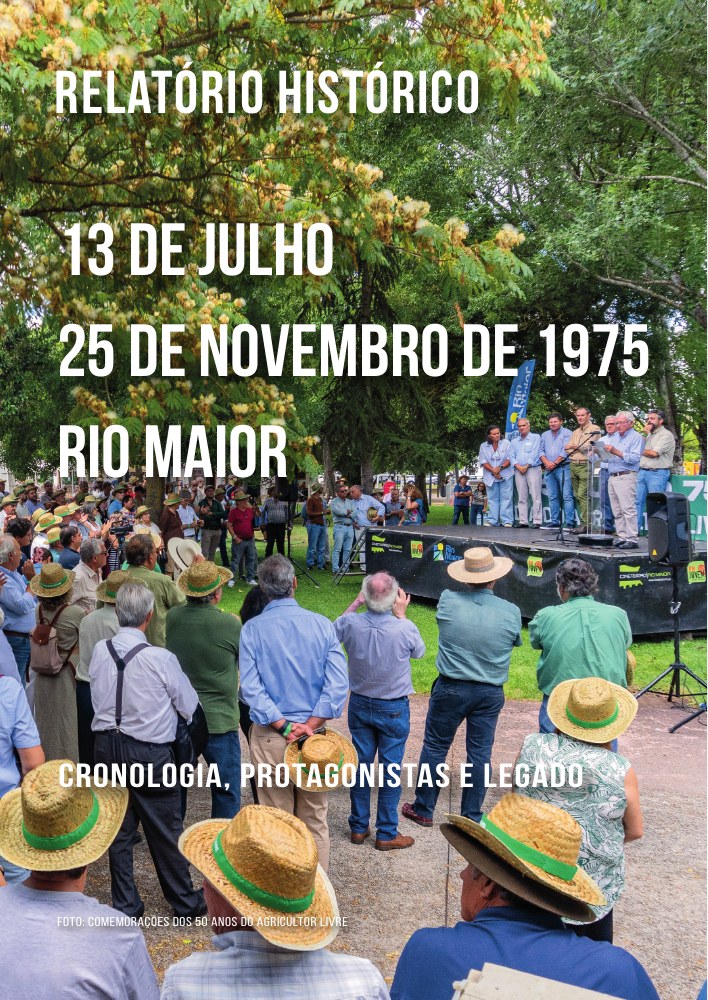
2026 edition · Original document
Chronology, protagonists and legacy
13 July and 25 November 1975 in Rio Maior. A publication bringing together historical accounts, testimonies by Joaquim Nazaré Gomes, speeches and photographs of the celebrations.
This page provides an editorial summary of the report, which brings together testimonies and interpretations of the events. References use the printed page numbers; links open the corresponding page in the original Portuguese PDF.
01 · The events
13 July, step by step
Defending the Grémio da Lavoura
The report places the mobilisation in Rio Maior within the tensions of Portugal’s Hot Summer of 1975. It presents the dispute over the Grémio da Lavoura, the local agricultural organisation, as a meeting point between fears of land occupations and the defence of farmers’ autonomy.
In this account, news of a meeting organised by the League of Small and Medium Farmers of Alpiarça circulated the previous day. On the morning of 13 July, farmers and other residents gathered outside the Grémio to prevent what they understood to be an attempt to take over the premises.
Clashes and repercussions
The text describes the escalation into attacks on the local PCP and FSP party offices, including damage to property and physical assaults, followed by military intervention from Caldas da Rainha. The conflict continued through disputes over press coverage, the destruction of newspapers and expressions of support for the farmers.
The report interprets these events as the point at which a local dispute acquired national significance.
02 · People and testimonies
Joaquim Nazaré Gomes and the protagonists
Organising, representing and remembering
The publication presents Joaquim Nazaré Gomes as a participant in the farmers’ mobilisation, a representative in talks with the authorities and a witness who continued to recount the events over subsequent decades.
His story connects the defence of the Grémio with the farmers’ delegation to Belém. The report also attributes to him a critical reflection on the violence against local communist activists, distinguishing political conflict from personal relationships between neighbours.
A network of leaders
José Manuel Casqueiro appears as a key figure in coordinating the national farmers’ movement. Luís Madeira and Guilherme Jacinto are identified alongside Casqueiro and Nazaré Gomes as members of the delegation that travelled to Belém on the night of 24–25 November. The publication also discusses Adelino da Costa Bernardes and the memory of the region’s farmers.
03 · From July to November
The barricades and the meeting at Belém
The gathering on 24 November
The second part of the report follows preparations for the farmers’ gathering in Rio Maior. It describes the work of the associations and the National Farmers’ Secretariat, their meetings and the formulation of demands concerning property and agricultural policy.
The account describes roadblocks on the night of 24–25 November, including disruption to the Lisbon–Porto road and the Western railway line. These actions are presented as a means of putting pressure on the political authorities.
The farmers’ delegation
According to the testimony reproduced in the report, Casqueiro, Nazaré Gomes, Luís Madeira and Guilherme Jacinto took the demands to Belém in talks that continued into the early morning. The publication connects this civilian mobilisation with the context of 25 November and highlights the significance attributed to it by the participants.
04 · Farmers’ organisations
From the National Secretariat to CAP
From local action to national representation
The report highlights the associations that brought farmers from different regions together. It presents the National Farmers’ Secretariat, active in Rio Maior, as a coordinating body and a precursor to the Confederation of Farmers of Portugal (CAP).
The move towards institutional negotiation
The creation of CAP is presented as a lasting legacy of the mobilisation of 1975. In the report’s interpretation, political stabilisation and the organisation of the sector changed how farmers pursued their demands, moving progressively from street action towards representation and negotiation with institutions.
The text also considers the diversity of farmers’ interests and the changing priorities that accompanied this transition.
05 · The wider context
Portugal and the Cold War
The fears shaping the country
The international chapter explores how rivalry between the Western and Soviet blocs shaped interpretations of Portugal’s crisis. It discusses the PCP’s relations with the Soviet Union and the attention paid by the United States and European allies to political developments in Portugal.
Connections with local experience
The report links this climate to the farmers’ expressed fears of collectivisation. It distinguishes the international context from direct intervention in Rio Maior, for which the text itself presents no evidence. The chapter helps explain the political significance participants attached to defending their land.
06 · Memory and rural life
What remains after 1975
Commemorating and passing on memories
The publication follows the preservation of memory through Free Farmer’s Day, place names, testimonies and the fiftieth-anniversary celebrations. It also acknowledges contrasting memories: a defence of freedom for the farmers and political violence for those who suffered the attacks.
New questions for agriculture
Its discussion of rural life highlights generational renewal, abandoned farmland, water management, sustainability and technological modernisation. It connects these themes to the continuing need for farmers’ representation and participation in decisions about the land.
This part of the publication primarily uses 2025 as the reference point for its discussion of agricultural challenges.
07 · Voices in the publication
Speeches and Free Farmer’s Day
Remembering 25 November
The opening includes a text signed by Joaquim Nazaré Gomes on the connection between agricultural mobilisation and 25 November. This first-person recollection focuses on the farmers’ organisation and their contacts with military officers.
Celebrating and passing on experience
Adriana Agostinho’s address recalls the fiftieth-anniversary tractor parade and connects freedom of initiative with the demands of agricultural work. Joaquim Nazaré Gomes’s speech thanks those supporting the celebrations and stresses the importance of passing the experience of 1975 on to younger generations.
The photographs of the celebrations throughout the edition extend this connection between historical events and the community that remembers them.